28 January 2008

The 11 layers of citizen journalism, and that's just the beginning.

Steve Outing presents some interesting facets of citizen journalism in his article, "The 11 layers of citizen journalism." Media are now a two-way street, and with internet and blogs around it can't be denied that the line between citizen and journalist is blurred. 

Among the most interesting of Outing's article was the fifth part in which he writes about a reader blog-ombudsman hybrid. An ombudsman is someone independent of the newspaper who criticizes and commentates on content, in attempts to keep a check on the paper's ethics. Anyway, I found it interesting because most media websites have some way or other for readers to make comments in response to stories, but there's often no way to critique the paper as a whole. That's where a reader-blog would come in handy. Of course, there'd still ideally be some editorial control over it, just to make sure comments are moderated and no one is libeled, but otherwise it should be fair game for readers. 

I wonder how familiar readers are with ombudsmen. It speaks mountains of the organization if it's willing to openly accept critique; it shows that outlet is listening and wants to know what the public thinks, what should change about its reporting. Allowing comments to be posted on stories is one thing, but I don't think that goes far enough.

For it to work properly, the media outlet could select a few ombudsmen from different areas -- maybe experts in education, government, criminology, etc -- and have them critique stories and write commentary, spurring reader comments. I don't know if it would be a good idea allowing Joe Citizen access to post his own full-length blog, but what about taking a look at some of the social networking sites and adopting their use of "walls", encouraging users to give feedback.

Another interesting aspect of citizen journalism that Outing presents is the hyper-local reporting. I don't think traditional journalism will ever die ( I mean, can you honestly replace the sweet feeling of waking up to a Sunday paper and browsing each section, sipping your coffee and munching donuts? Kindle, you have nothing on the paper copy.) In that regard, as buy-outs and mergers threat traditional journalism, it forces us to be more selective in what we cover, since there are less pro journalists, and newsworthy events go uncovered. So, we have to utilize technology to the max. The school board meeting might not take priority, even though it's important, and it affects many people, but the journalist is busy elsewhere, so why not ask faithful readers to volunteer and cover the meeting? For example, I interned last summer at the Austin Post Bulletin, and I went to a city council meeting in which one of the issues was a proposed expansion of a vet clinic, but the land was needed for flood mitigation. That story never made it on the pages. To Joe Reader, he'd say, "Why do I care that this is printed in the paper? This only affects that neighborhood." But still...that's an entire neighborhood. This type of hyper-local journalism borders on community newsletters, but hey, it's news, and it affects people, and things like these can cost taxpayers money. This is where dedicating blogs and assigning a few citizens in each quadrant to cover what goes on, would be greatly beneficial and of interest to those readers. The world is becoming more globalized, but at the same time, as a result, we crave "more local," in the mess of mass media. 

***

Besides the facets Outing presents -- of which I agree with most of them -- there are many he left out. The article was written three years ago, but if he were to rewrite / update it, it might be called the 29 layers of citizen journalism. Ok, maybe not that many (or maybe even more??!), but here's what he might've included:

1. YouTube. You might've heard of it. This has revolutionized how we watch videos. The traditional tube has eroded and we depend more on viral videos for our news, entertainment, information, class lectures (you can attend U of Berkeley free!) Anyway, what YouTube does for citizen journalism is it lets any Joe Schmoe take a video of whatever, and post it online at the disposal of millions (billions?) of potential viewers. YouTube is to owning your own TV station as blogs are to owning your own newspaper. True, you don't need YT to post videos, but no other site has been so popular, accessible and centralized as YT, effectively putting you in contact with more viewers than all of the Superbowl shows combined. Want to start a group that broadcasts twice-monthly firefighter meetings in Taopi so that the rest of the 89 inhabitants of the town can see what motions are passed and find out which avenues will get new reflector signs? Easy as pie. 

2. Social networking sites. Whereas news organizations depended on exclusive databases to get their contact information for sources, they now have an insanely amazing tool to reach millions of people, especially youth and college students. Facebook, Myspace, Hi5, etc., are places you can get phone numbers, emails, interests, hobbies, religious/sexual/political preferences, etc. etc. -- basically, phonebooks, directories, databases, etc., combined into one centralized location, and Joe Citizen Journalist now has access to potentially millions of sources. I've used facebook for stories -- not necessarily for writing -- but for reporting, for finding sources and getting contact info that's unavailable elsewhere. At the same time, social networking is dangerous to citizen journalism, as anyone can make a forum, post something as if it were factual, and -- get this -- news organizations actually quote what is written as fact. Case in point: someone posted an account of what hapepned the day Rissa Amen-Reif died, and media cited the events as if they were true. Dangerous.

3. Cell phones. Most cell phones come with cameras, and this allows Joe C. Journalist to possibly take real-time video of news events. During the Virginia Tech shooting, students used their camera phones to record the action. And with broadband / wifi networking, it becomes even easier to transmit that video to a blog, post it, perhaps beating even the 4 big TV stations. 

&&&

Those are only a few of the layers of citizen journalism; I can think of a few more, but those are probably the most important since Outing wrote his article. What have you got, Journalism U'ers ??

22 January 2008

one size fits all

Eight months is too long to have a blog and not post. As my mass comm. professor Ellen calls it, a puppy: exciting to get, and for the first few weeks cute and fun, but when it turns into a dog, all the maintenance and attention make you wish you never got it.


My puppy is dead.

But I got a new one...kind of...in the form of a blog for a class.

At least I'll be updating more frequently this semester, since my grade depends on it.

Cheers to puppies.


***

— Anyway, just in case you newbie readers are wondering, Bralapa means Bronson + Xalapa. Xalapa is the Mexican city in which I studied a year.

— Click on the ads above to help fund my scholarly pursuits. I suggest all you bloggers, especially those in my class, sign up for Google AdSense: let Google put ads on your site and you earn money when users click them. Hardly anything, but it's a nice bonus for doing homework.

20 May 2007

Mexmex

In three weeks I leave Mexico, three very short weeks. Where have these nine months gone?! Since spring break ended five weeks ago, the days fly by and my time here gets less and less. One day has 24 hours but feels like 5 minutes. So, have I accomplished every thing I set out to? Have I reached my goals? Or have I simply wasted away these nine months in useless cultural observations, lazy wandering and indulging in Mexican food?

Of course not.

I can speak Spanish near fluently now. When I started I was a beginner, despite four years of study in university and high school. I thought, upon arriving 22 of aug., "no problem, I can get around easily and I know enough, it`s cake." WRONG! I had a hard time even ordering a meal in McDonald`s, where half the words were brand names - Coke, Big Mac, Visa - and before beginning my classes I was dismayed to find that I placed level 3 of 6 in this school`s intensive Spanish levels, which meant I was low-intermediate level, still ineligible to take university-level classes with Mexican students. But maybe it was better that way, as I tried harder and worked more to attain more Spanish. Many have told me I don`t have a gringo accent, on some words yes, but most of the time they can`t tell I`m American, but I`m lucky in that I`m moreno, my skin is darker and at the very least I look Central American, where the people`s skin color is lighter than that of Mexicans, usually, and for that reason I tend to fit in better.

Anyway...


Have a look at these popular Mexican brands...


-Pemex: Petroleum Mexicano, petrol monopoly, the only gasoline you can buy in Mexico
-Telmex: Teléfonos Mexicano, telecommunications monopoly. Mexicans pay some of the highest phone rates in the world. It costs about 40 cents per minute to call a cell phone under TelCel, and 35 cents to use a payphone per minute. But no wonder, the compnay is owned by the world`s second richest person, Carlos Slim.
-Jumex: Jugo Mexicano, asshole juice company that supported election of conservative president Felipe Calderon
-Comex: Colores Mexicanos, every brightly colored house probably was painted using this company`s paint
-Banamex: Banco de Mexico, National bank, beareaucratic, my friend`s debit card was eaten by their ATM.
-Cemento Mexicano: Cement.
-Mexpost: Mexican Post: it probably won`t arrive.
-Cinemex: Haven`t been there
Coming soon...Bromex, which will buy out Bralapa in a landmark merger.


And now, here are two essays I`ve written: the first a "slice of life" as I take a bus ride, the second is advice for those studying abroad, both published in my college newspaper....


***

Everyday Cultural Oddities

A Slice of Life Seen from a Mexican Bus


I write this as I wait for the bus. It will be egg-yolk yellow and falling apart. Looney Toons stickers and soccer garb will plaster the dashboard and a crucified Jesus or Virgin of Guadalupe mini-shrine will be rubber-cemented on the windshield, which will have spider-web cracks and the names of its stops – Centro, Berros, 066, Bugambilias – neatly painted on the outside corner.

This is Mexico and I love it. In these past eight months I have cut a chunk from my heart and planted it in the rich Mexican soil, the country whose flag depicts an eagle devouring a serpent while perched on a cactus.

I board and pay the driver – or chauffeur as they call him – three pesos and realize that on this ride I’ll be standing in the aisle, as every seat is occupied. The bus kicks in gear, spits out a cloud of black smoke and continues on, sending the glass clacking against the panes and the doors and seats bouncing as if they’ll come unhinged due to the worn shocks taking every imperfection in the road quite seriously.

An old woman boards and squeezes past me.

“Can I please pass sir? Thank you,” she says, and sits with a friend, who she kisses on the cheek and asks about his family. He tells her how nice it is to see her after so long.

I’ve met few Mexicans I’ve disliked. Most are polite, patient and friendly. You get lost and ask someone how to get to your destination. The Mexican will not only tell you how to get there, but go with you to make sure you’re on the right path, while asking you where you’re from and how many siblings you have, and once you leave he’ll shake your hand and tell you to take care.

The bus stops in the long line of traffic, half of which is old VW Beetles and red Nissan taxis. I look out the window and a lady cuts freshly killed chicken as customers make a line on the sidewalk, and next to her a grandma sits on a blanket and peels prickles off cactus which will be eaten in a comida corrida, fast food Mexican style. Across the street is a funeral parlor, which is next to a dentist`s office, which is beside a saloon, which neighbors a tortilla shop, which is adjacent to a convenience store run from the garage of an old man. A friend said all buildings should be painted white for aesthetic reasons, but I told him I liked Mexico’s chaotic beauty, its stylish disorder.

Finally the traffic thins and the bus chugs up one of Xalapa`s many steep hills, past a crowded cluster of apartment buildings and a high school kid playing Jarocho music on his guitar, his black hair gelled and his uniformed girlfriend watching him. I’m running 15 minutes late to class, but the professor still isn’t there, and no one complains. Meanwhile a girl has her “Sweet 15” party, a paraplegic sells lottery tickets in the downtown and a group of politicians meets to argue abortion, one of them corrupt, one pro-choice and one with a baby on the way. A teenager watches poor-quality Mexican soap operas, a farmer cuts sugar cane with a machete and a boy lies dead in a Mexico City subway station.

Two minutes ago we were in a slum and now we pass through a ritzy neighborhood, where a white, blue-eyed Mexican boards, who sits next to a dark-skinned indigenous woman who is in front of a golden-brown teenager who is beside a black toddler. Mexico’s language is not Spanish but a generous helping of indigenous and American English vocabulary, as evidenced by the various advertisements on the inner walls and outside of the bus. Now and then professors spit out English words and phrases while giving classes to students named Xochiquetzal and Tenochtitlan.

Finally we arrive to my stop, where I get off and thank the driver. I pass a farmer selling fresh mangos from the back of his truck, a homeless woman passed out, a palm tree, a kid vending fingernail clippers and two stray dogs going at it. Entering the school I meet a group of friends who invite me to eat pozole soup and go salsa dancing later tonight. I gladly accept.

Colonial architecture, white-sandy beaches, jaguars, snowy mountains, pyramids, Catholicism, free health care, rapid growth, countless holidays, clogged drainage, machismo, tequila, family, skyscrapers, a festive approach to death, petroleum and phone monopolies, a bread company called Bimbo, dubbed movies and lucha libre. Contrasts, variety, inequality, discrimination, poverty, tranquillity, contamination, overcrowding, congeniality, generosity, strong traditions, modernism, chaotic beauty and stylish disorder.

This is Mexico and I love it.

***

Advice for the wanderlust

A few hints from a Mexican study-abroad staffer


By now you have made the decision of how you will occupy yourself next year, and if it’s deciding to study abroad, you’re making a great choice.

But be careful, especially in the planning stage. As college students, every penny and ounce of research matter. You already know that foreign time will open your mind, boost communication skills and make you more cultured. I want, however, to give you advice no person or book told me, based on my two semesters in Xalapa, Mexico.

The options are mind-boggling and don’t let MSU-planned programs limit you. Since I have not enrolled in MSU´s programs, I cannot criticize their quality and worthiness, but enrolling directly in a language school, becoming fluent in Spanish, and saving thousands of dollars, it’s been worth it. Despite criticism and intimidation from some faculty in planning last year – that I would learn nothing, that the school would be of poor quality and that credits wouldn’t transfer – I’ve gained the experience anyone gets studying abroad, whether it’s an MSU-planned program or an independent study.

To go independently requires more paperwork, dedication and research. It’s intense but many people will help you – just ask. If you go solo you may receive opposition, intimidation as well as pressure to learn just as much, as I did, but thorough planning leaves room for few problems.

One benefit of directly enrolling is savings. I attend the University of Veracruz, one of Mexico’s best, and pay $1,075 per semester for 19 credits or four classes. I chose to live with Mexican students from the start instead of with a school-sponsored Mexican family (about $600 per month), and it’s cost me $5,500 for ten months ($140 per month for rent and utilities and $410 for everything else). In addition, I’m still enrolled at MSU and receive the grants, loans and scholarships I would normally get, while some of MSU`s study-abroad programs charge you the cost of the foreign school plus MSU tuition, even though you are not physically taking classes there. For example, MSU`s Guadalajara, Mexico program costs about $7,000 per semester, not including airfare. And while the average Mexican earns $10,600 per year, it is ironic to spend $7,000 in 15 weeks in a developing country.

Other advice:

It’s recommendable to know the country you’re studying and more importantly to know your own. Frequently I’m asked my opinion of the border wall, immigration, George Bush, the war and American television. It surprises me how much foreigners know about my country – sometimes more than I do – and how little I know about their country.

Avoid spending too much time with English speakers. It’s easier but you lose chances you’d spend with locals learning slang or adventuring solo. In one embarrassing instance, a graceless blond run up to a farmer, donkey behind him, asking if she photograph him. He declined but she offered him a few pesos, which was even more insulting. Americans often have a bad image in many countries, perhaps the worst in the world, and it worsens each day thanks to our polluted media and incompetent president. You will affect every person you meet and their opinion toward our country, so it is in our best interest to be thoughtful and competent.

Get a local lover. Having a romantic fling from your host country quickly submerges you in culture nuance as well as tests your confidence, especially when learning another language. And who knows, the path to dual citizenship might become less complicated.

Be sensitive. It’s uncomfortable to see foreigners mocking locals because they do something different. One time I was in a taxi and an American was dissing the driver behind his back for the way he drove. Although this was in English, many Mexicans understand and speak our language well.

Living like locals is a humbling experience and makes for interesting stories. Street food gave me intestinal parasites once and riding second class busses from Mexico to Guatemala City was a discount ticket to death, but I wouldn’t otherwise have mistaken chicken sandwiches for dog meat or see people who live on the side of mountainous highways selling life-size wicker reindeer.

Read the newspaper. By reading the news you not only learn the country better but pick up faster on unknown words. On Mexican media – seeing that almost every day a handful or so are murdered due to drug trafficking-related instances (23 on the day of the Virginia Tech massacre), often journalists, and the death threats pro-choice supporters receive (last week abortion was legalized in Mexico City), I have more confidence in our freedom of expression, no matter how unfair it seems.

Enjoy the honey-moon period. Upon arriving everything will be new and exciting. This stage has been the most fun for me, and similar instances reoccur, but it’s called “honeymoon” for a reason, and when that ends the culture shock begins.

Finally, be prepared for anything. Not just in your host country, but back home as well. In the past eight months two relatives died, one sibling got married, one went through puberty, one began to drive and one became an adult. One cousin got pregnant, one returned from Papua New Guinea, one went to Harvard and one moved out. People age, get sick and die. Some change and some stay the same. Your challenge upon arrival will be re-adapting to everything you missed. And going home in less than six weeks, that is what I fear the most.


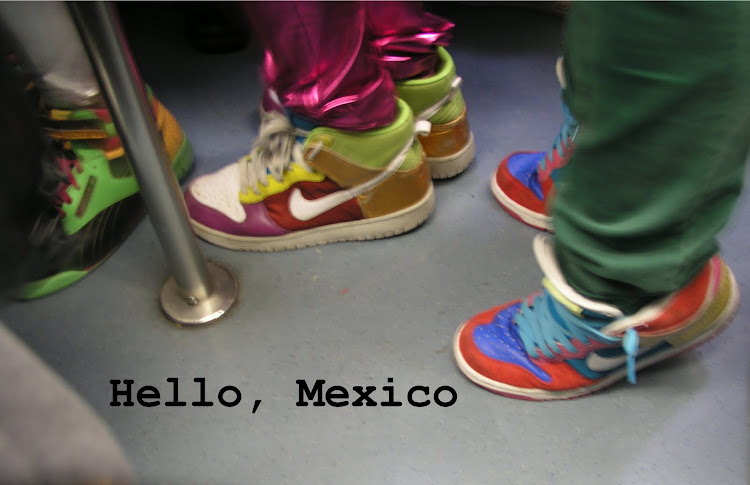
Photo of the day...


One of Mexico City`s staple green VW taxis cruises in the southern part of the megalopolis April 12, with a clear, smogless view of the mountains in the background.
28 April 2007

Trash in Mex

I write this with only six weeks to go in Mexico.

:(

...and then,


:)

!!

So, I should take full advantage of my time here, and share some blog experiences while they are still interesting. After all, when would you see a parade of Lucha Libre wrestlers, the Virgen of Guadalupe and the Tasmanian Devil at the same time?


...wtf?


Anyway, with that, I would like to choose a topic of the day and write a little of it. Today´s shall be...


Mexican Garbage.

One surprising aspect of Mexican Garbage, or more specifically, Xalapan Garbage, is that it´s free to dump it. Every night except Sunday a truck passes our house, grinding it´s gears to the max and pumping out large clouds of black exhaust as we live on a steep hill, and collects a mountain of garbage, some in bags and some not, that get piled near a multilevel hospital parking garage. What you can find in the garbage differs from American garbage, as it contains 1. more fruit peelings and 2. used toilet paper that is unable to be flushed. As a whole, Mexicans waste less than Americans, or rather, -every one- wastes less than Americans. You go into a house and the furniture is old and smelly, the tiling ridiculously outdated, the fridge propped up by bricks as the pegs have broken off, the living room TV 13 inches and 20 years old. But it functions and there´s no real need to replace it. Obviously this is a much poorer country than mine, but as a whole I think there is more respect for the material, the people are less materialistic and it is not as important to have new things to impress others. There is at least one exception, however: cell phones. Many Mexicans, even the poor ones, often have nice cell phones, and are always sending text messages. To make a call in this country is absurd. It costs at least 3 pesos - 30 cents - per minute, even from a cell phone, and pay phones are even more. I think one big reason is due to the telecommunication monopoly, which is owned by the world´s third richest man, Carlos Slim.

Anyway, garbage. You also find a lot of it on the street. I´m referring specifically to Xalapa. Some places are disgusting. In the mornings, at dawn, you see workers out on the streets, using big brooms, the bristles made of sticks or flexible tree bark, sweeping away the accumulated rubbish, making the city clean for the next few hours, but later the litter comes back with the hustle and bustle. But it is irritating that there are very few trashcans. With good reason the trash is tossed on the street - the bins are inconveniently located and they always seem to be full. When I went to Costa Rica there were trash cans every where, many of them with beautiful painted designs. But in Xalapa such is not the case.


Another thing that irks me is the lack of recycling. I know of one recycling place, which is far from the center, and the garbage truck doesn´t carry seperate bins for the reusables. One good thing, however, is that plastic bottles and beer containers are almost always returnable for cash or more beverages. You are obligated to recycle when you drink beer or Coke.

The four of us (Stacy, Carlo, Ahmed and I) who live in this house have a small garden , or rather a large cement trough filled with dirt, where we throw all the fruit peelings and seeds instead of in the trash. The bad thing is, it attracts lots of insects, so the mosquitos get into the house and remind us that garbage is never free.


--Pic of the day--


Two lovers - or rather, one lover and one surprised woman - share an intense, romantically confused moment overlooking Teotihuacan´s Pyramid of the Moon, north of Mexico City one cloudy afternoon.

14 April 2007

Cluttered mind ramblings

I think I`ll post the third part later. It is probably the most interesting, but I need a lot of time to write it since it`s so massive. And a lot of time requires some dedication and patience, and I`m just feeling lazy right now, so instead I will post something I wrote three weeks ago, which is a different style of blogging. What I did was spoke into a voice recorder, grabbing my thoughts and then typing them out. It`s more candid, more honest and maybe even more interesting since writing can retard the thinking process, but it may be more difficult to read.

No apologies for bad grammar or misspellings.

....

Thursday 22 march 2007

6.00 p.m.

Well right now I´m feeling ecstatic because I just got a n email in my junk mail box actually and its from the editor of the austin post bulletin she told me that I had gotten the internship this summer writing news and this is good for several reasons. One because I need the intership to graduate. Two because there are few intership options availbe in Austin for mass comm. Majors. Three because itll improve my wrting. Four…uh..oh yeah, cuz i´ll be editor in chief next year at the msu reporter an award winning college newspaper. I´ll need more skills to help my writing improve. I guess this is similar to the third option. Yeah. But yeah. I´m frikkiin happy I got this internship. I applied for this internship last year as well but never got it. And I´ve been freelance writing for the Bust bulletin for two years now. Well just a few articles at a time: i´ve wrote se evn so far. And what else…uuhhh….lets see here…ohyeah i´m also happy right now because i´ve been drinking coffee all day and caffeine always puts me in a good mood. For some reason I don´t know why. It has different effects on other people. And….um…lets see. What was I gonna say. Yep some days I just wake up in a good mood. OIther days I don´t. And that just sets the tone for my hwole day I guess. And sometimes I wake up and it hink about my dad. And how he´s dead and how it would be like if he was still alive today. How we could´ve stopped him from dying. And just memories about him. And that happens almost every day in fact and I dunno why. I don´t have a lot of dreams about him but I usually don´t remember my dreams, just little fragments of them. And its likie when I wake up in the mrngn and I cant remember my dream. Its like in winter and you know those little puddles of water and …ok where was I …oh yeah…uhh….ok…anyway….when it´s the winter theres the little p’uddles of water and they start freezing from the cold and you get these thin little layers of ice and when I was a kid I always tried to pick up the layer of ice and throw it and it sounded like glass breaking and itw as pretty cool. And yeah,anyway. My dreams are like those, thin sheets of ice. As soon as you grab hold of them, try to get the sense of them, they break they shatter they fall apart they fall to pieces you don’t remember them anymore and that’s what its like when I dream. And I haven´t had many clear dreams of my father since he died. I´ve had a few but they were nightmjwares. And I don’t wanna talk about htem. I just don’t. And I think that’s interesting that he´s the first thing I think about when I wake up in the morning. And I guess its just a part of the healing process you know. And the whole days not like that I think I would go crazy if that happened. But I just like see thigns that remind me of my dad like in my room for example when he died I brought back one of his work tshirts. It´s an X X X X L size, which is four ex, and I guess I could probably cut the material up and use it as a jumper. That’s how big he was. Anyways black tshirt. He used it to when he went to work. He was a welder um and its full of holes, some big some little. Little pecks. And anyway uh it has small holes from the sparks when he welded and I remember when he used to wear this shirt in particular you could see the little hairs on his fat belly poking out of the shirt, the holes, and plus the shirt wasn´t even big enough. I mean four xl is friggin huge but this man was like well he was fat. And yeah the bottom of this shirt it reached a little below his belly btton bt nt all the way so you could see his uh..what do you wanna say…stomach cleavage…haha I know theres a word for th at but I can´t think of it right now but yeah anyway it was very attractive. And so. Lets move on to a different subject now. Xalapa. Xalapa xalapa. Xalapa is a small city stretched to the limits of a large city. That’s how id describe it. Cuz you have like the downtown which is like it looks like a medium sized city of 50 000 people but then having it stretched out to the limits and its kind of a mess becuz you have u h it’s the capital of the state and so many people are migrating here and it wasan´t designed to be a big city and it was a small city and you can see how much development is happening even now I mean like just getting to school in one of my classes in the university I have to take a bus there and it takes about 45 minutes walking from my house to the school and its just way out there but by bus it takes porbablyu 25 to 35 minutes and i´d say a good 5 or 10 minutes of that is just waiting in traffic and its that slow. And you have tons of cars and you have narrow, winding, hilly streets, and now imagine that and…yeah just imagine that and its crazy. And a lot of people say it´s a small Mexico City and I wouldn’t doubt but its just rapidly expanding, crowded, uh, polluted, uh…itsa surrounded by mountains, smoggy, the weather is…the weather is it´s nice. It gets hot but not too hot and it gets cold but not…well it gets cold some days I wish iw as back in Minnesota just kidding. But…what else can I talk about here…mmm…i´m still going out with María Fernanda my Mexican girlfriend 19 years student of law, uh she´s from Xalapa she lives by me about ten minutes from my house walking um…attractive, slightly resembles Scarlett Johansson, curvier, shorter, much darker, has, uh, changes her hair color once in a while, it´s always black but she has like tints like blond. The first time I met her it was purple the tints and since then it hasn´t been as crazier. Just red or brown or light black, dark blonde, stuff like that. Uhm, what else here. Today. I can describe what happened today. I woke up at about 7 am